








Key Takeaways
- 1.Revenue acceleration is about increasing revenue velocity by fixing response time, routing, qualification, and handoffs—not generating more leads.
- 2.The biggest gains come from speed to lead, accurate routing, real-time qualification, and automated workflows that remove manual delays.
- 3.Most revenue loss comes from execution gaps: slow follow-up, misrouted leads, duplicate data, and unclear ownership.
- 4.High-performing GTM teams enforce instant routing, clear ownership, and system-driven execution so leads are worked while intent is still high, not after it's already gone to a competitor.
Revenue acceleration isn’t about generating more pipeline. It’s about how quickly your existing pipeline turns into revenue. That’s where most teams break down.
Leads sit in queues. Routing rules drift out of date. Ownership gets fuzzy. By the time sales follows up, the buyer has already moved on or started a conversation elsewhere.
In this guide, we break down a practical framework to fix those gaps so you can move faster, convert more pipeline, and build a revenue engine that actually scales.
What revenue acceleration actually means for CROs
For most CROs, revenue acceleration shows up in the same places every time. Leads aren’t worked fast enough. Routing breaks. Good opportunities get buried under low-quality ones. And pipeline slows down before it ever has a chance to convert.
Fixing that comes down to tightening how pipeline moves across a few key stages:
- Lead response time → engage high-intent buyers immediately with a sales call to avoid lost deals
- Routing logic → ensure leads reach the right rep without delay
- Qualification workflows → prioritize real opportunities, not low-intent leads
- Sales handoff speed → move leads from marketing to sales instantly
- Conversion bottlenecks → eliminate friction where deals stall or drop off
Most teams can point to these issues. Fewer actually fix them.
Instead, they add more pipeline and hope it covers the gaps. In practice, it’s a short-term patch on a system that’s still leaking revenue underneath.
The 4 core drivers of revenue acceleration
Revenue acceleration comes down to four system-level drivers. When these are dialed in, pipeline moves faster, converts more reliably, and becomes easier to predict.
Speed to lead (revenue is won in minutes)
For demand gen and sales leaders, response time is where most conversions are won or lost.
- Leads contacted within minutes convert significantly higher
- Delays lead to rapid intent decay or competitor engagement
- Manual assignment and queues create silent leakage at the top of funnel
High-performing teams remove that delay entirely. Leads are routed and assigned in real time, so high-intent buyers are engaged while they’re still active.
Intelligent lead qualification
For RevOps, qualification isn’t just scoring. It’s deciding where revenue attention goes.
- Manual qualification slows pipeline and introduces inconsistency
- Static scoring misses real-time buying signals
- Sales teams spend time on low-probability leads while stronger ones get missed
Top teams treat lead qualification as a live decision layer, using behavioral and firmographic signals (often powered by Artifical Intellingence) to prioritize what actually has a chance of closing.
Effortless marketing → sales to customer handoff
This is where a lot of pipeline quietly breaks.
- Ownership isn’t always clear across accounts
- Account matching creates duplicates or routing conflicts
- Leads get reassigned or delayed before anyone follows up
When this layer works, leads move instantly from marketing to the right rep, with clear ownership and no gaps.
Workflow automation across the revenue engine
Most revenue engines still rely on too many manual steps.
- Processes depend on reps remembering to act
- Systems don’t sync cleanly across teams
- Execution varies depending on who’s handling the lead
High-growth teams don’t leave this to chance. Routing, qualification, and follow-up are handled by the system, not the rep, so execution stays consistent as volume scales.
If speed to lead and routing are where things break, Default’s lead routing software can enforce instant assignment so high-intent leads don’t sit in a queue while the moment passes.
Why most companies struggle to accelerate revenue
On paper, the pipeline looks fine. In practice, a lot of it never gets worked properly.
Leads sit longer than they should. Routing rules fall out of date. Ownership isn’t always clear across accounts. And by the time someone follows up, the moment has passed.
You can see the pipeline. Controlling how it actually moves is a different story.
Here’s where revenue typically breaks:
The result is constant revenue leakage. Not from lack of demand, but from a system that can’t convert it.
Revenue acceleration framework for GTM teams
Revenue acceleration comes from fixing how your pipeline moves, not adding more tools.
This framework gives you a set of best practices and a practical, repeatable way to remove friction, increase speed, and improve conversion across your entire revenue engine.
Step 1: Diagnose revenue bottlenecks
Start by identifying where your pipeline slows down or breaks. Most issues are hidden in response time, routing, and stage conversion.
Focus on:
- Leads sitting unworked or delayed
- Stages with the highest drop-off
- Routing errors or unclear ownership
Step 2: Automate routing and ownership
Manual lead assignment creates delays, missed SLAs, and lost deals.
To fix it:
- Route leads instantly based on territory, segment, and ownership
- Eliminate queues and manual reassignment
- Assign a clear owner the moment a lead is created
A common mistake: Static routing rules that don’t adapt to account ownership or real-time conditions. As territories shift and teams change, those rules drift out of date silently, and routing keeps firing on logic that no longer reflects how you actually sell.
Step 3: Implement intelligent qualification and handoffs
Qualification and handoffs determine whether pipeline moves or stalls.
To improve both:
- Use real-time behavioral and firmographic data to prioritize leads
- Filter out low-intent or low-fit opportunities early
- Enforce clear ownership and instant marketing-to-sales handoffs
- Apply deduplication and account matching to avoid routing conflicts
Step 4: Measure and optimize revenue velocity
Revenue acceleration is driven by how fast the pipeline moves, not just how much you generate.
Track:
- Lead response time
- Lead-to-meeting rate
- MQL → SQL conversion
- Sales cycle length
- Revenue velocity
This framework turns revenue acceleration into a system. And one that scales with your pipeline (instead of breaking under it).
If routing and ownership are where your pipeline breaks down, lead routing software can enforce real-time assignment and ensure every lead is worked instantly.
How high-growth companies accelerate revenue (real patterns)
High-growth GTM teams tend to fix the same things. Not by adding more pipeline, but by tightening how it’s handled from the moment it comes in.
Here’s what that looks like in practice:
- Product-led companies trigger sales at the right moment
Product signals drive sales engagement. As usage increases, leads are qualified and routed in real time instead of waiting for a form fill. - Inbound-heavy SaaS teams don’t leave response time to chance
Leads are routed and assigned instantly. Meeting booking is automated so demand is captured while it’s still there. - Hybrid sales + PLG teams get context at intake
Leads are enriched as they come in, combining firmographic and behavioral data so reps aren’t starting from zero. - Revenue teams rely on workflows, not manual steps
Routing, qualification, and handoffs are handled by the system. Every lead follows a defined path instead of depending on rep follow-through.
The pattern is consistent: leads are worked immediately, routed correctly, enriched early, and moved forward without manual intervention.
If that’s not happening, pipeline slows down (no matter how much you generate).
If you want to put this into practice without rebuilding your stack, see how Default turns routing, qualification, and handoffs into a single, automated system.
Revenue acceleration metrics CROs should track
If you’re not tracking where pipeline slows down, you won’t know what’s costing you revenue.
Here are the core metrics that matter:
These metrics tell you where revenue is actually getting stuck — and where to focus to move it forward.
Tools that enable revenue acceleration
Most GTM stacks are built around four core layers:
- CRM → system of record
- Enrichment + qualification → data + prioritisation
- Routing + ownership → execution at intake
- Automation layer → orchestration across the funnel
When these layers are disconnected, execution slows, and revenue suffers.
Default
Default acts as the execution layer across your revenue engine—connecting routing, qualification, enrichment, and workflows into one system.
Instead of relying on manual processes or disconnected tools, it enforces how pipeline moves in real time.
- Routes and assigns leads instantly, eliminating delays and queues
- Enforces ownership across territories, accounts, and teams
- Connects enrichment, qualification, and scheduling into one workflow layer
- Automates marketing-to-sales handoffs without manual intervention
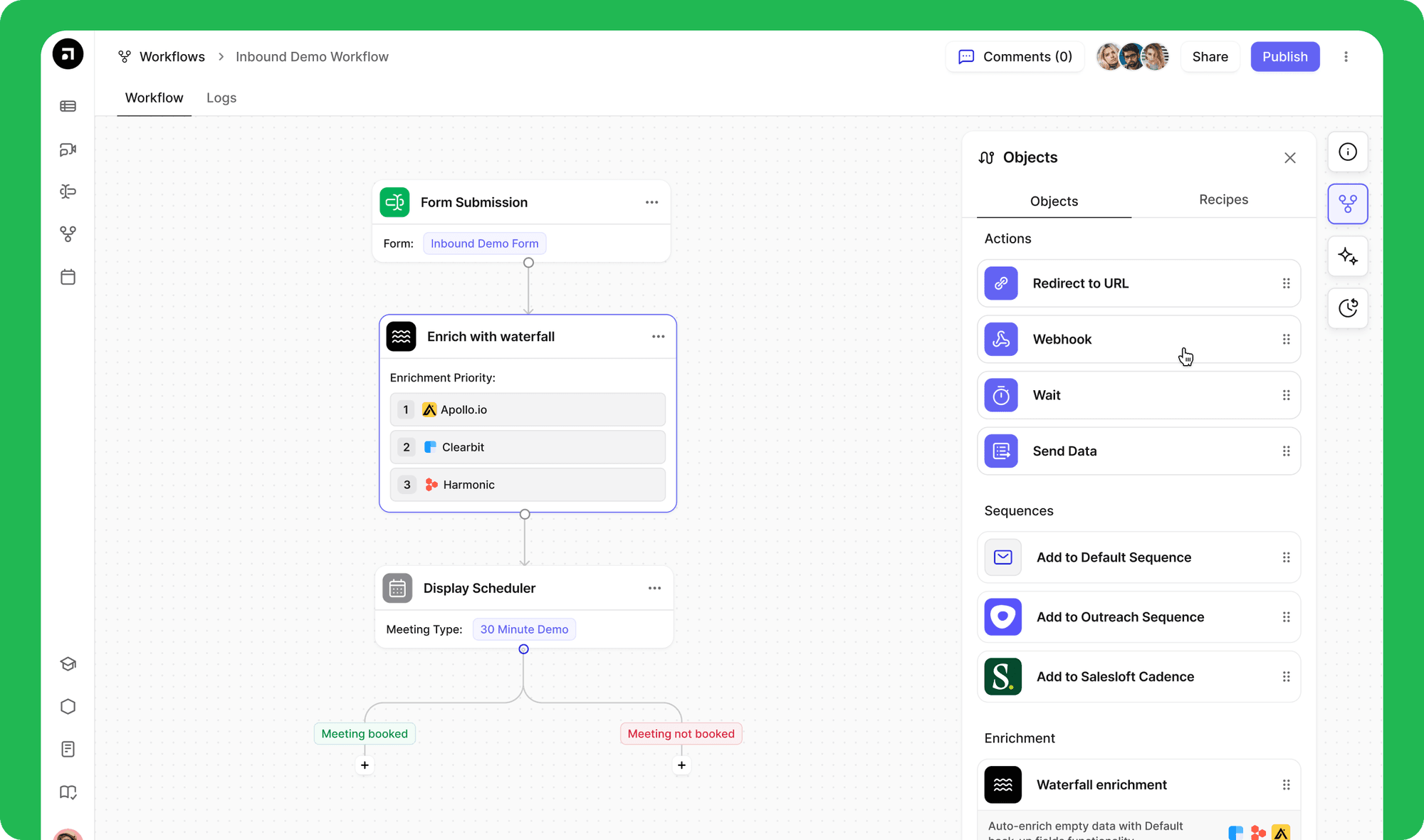
The result is a system where leads are assigned, prioritized, and acted on without delay.
If your current setup isn’t handling routing, qualification, and handoffs in real time, RevOps automation platform capabilities can bring those layers together into a single system that actually executes.
Salesforce
Salesforce acts as the system of record for pipeline and customer data.
- Stores leads, accounts, and opportunities
- Supports reporting, forecasting, and visibility
- Enables custom workflows and process configuration
However, Salesforce alone doesn’t execute in real time.
Routing logic is often complex to maintain, changes require ops involvement, and workflows can break as systems scale. Without an orchestration layer on top, speed and consistency become difficult to enforce.
Clearbit (and other enrichment tools)
Enrichment tools improve how leads are evaluated and routed:
- Append firmographic and account data at capture
- Improve segmentation and targeting
- Enable more accurate ICP-based routing
Data alone doesn’t move pipeline. It needs to be applied immediately through routing, qualification, and workflows.
If these layers aren’t connected, execution breaks down. Leads get delayed, misrouted, or never worked at all.
Build a revenue engine that scales — build it on Default
Revenue acceleration doesn’t come from replacing your stack. It comes from making sure it actually runs the way it should.
Default sits on top of your CRM and tools, connecting routing, qualification, and handoffs across the customer journey into a single system. Leads are assigned instantly, ownership is clear, and every step from capture to conversion happens without delay.
The result: leads are worked on time, routed correctly, and moved forward without gaps — and that's what actually converts pipeline, not more of it.
If you want to fix how your pipeline actually runs, book a demo and see what it looks like when routing, qualification, and handoffs work the way they should.
Pipeline doesn’t need to grow faster. It needs to move properly.
FAQs
1. What is revenue acceleration?
Revenue acceleration is the process of increasing how quickly pipeline converts into revenue. It focuses on improving speed to lead, routing accuracy, qualification, and conversion workflows — so existing demand turns into pipeline and closed deals faster
2. How is revenue acceleration different from demand generation?
Demand generation creates pipeline. Revenue acceleration converts it. Most companies invest heavily in generating leads, but lose revenue in how those leads are routed, qualified, and worked. Revenue acceleration fixes those gaps to improve conversion and speed.
3. Why do most companies struggle with revenue acceleration?
Because their execution layer is broken. Manual processes, poor routing logic, duplicate data, and disconnected tools create delays and inconsistency, leading to missed SLAs, unworked leads, and lost opportunities.
4. What are the most important revenue acceleration metrics?
The most critical metrics are:
- Lead response time
- Lead-to-meeting rate
- MQL to SQL conversion
- Sales cycle length
- Revenue velocity
- Routing accuracy
These metrics directly reflect how efficiently your pipeline moves and converts.
5. Do you need new tools to accelerate revenue?
No. Most teams already have the tools; they just aren’t connected or automated effectively. Revenue acceleration comes from building an execution layer that connects routing, qualification, and workflows into a single system, so leads are handled instantly and consistently.