








Key Takeaways
- 1.Chili Piper pricing starts at $15–$30 per user/month, plus platform fees ranging from $150 to $1,000/month depending on product and inbound volume.
- 2.Total cost scales with SDR headcount, bundled products, and monthly lead volume (not just feature usage).
- 3.Chili Piper is built for meeting routing and scheduling, not full-funnel qualification or lifecycle governance.
- 4.Default offers broader GTM orchestration (including enrichment, routing, and SLA automation) with more predictable pricing.
If you’re evaluating Chili Piper pricing in 2026, you’re not just choosing a scheduling tool. You’re deciding how your GTM engine scales.
Chili Piper uses modular, per-user pricing. Costs increase as you:
- Add routing products
- Grow SDR headcount
- Increase inbound lead volume
The real question isn’t the starting price, it’s: what happens when you scale?
Below, we break down plans, platform fees, hidden cost drivers, and compare it directly with Default so you can assess total revenue impact, not just seat pricing.
How much does Chili Piper cost?
Chili Piper pricing in 2026 is seat-based, with additional platform fees tied to product type and inbound volume. Total cost increases as you add modules, expand SDR headcount, or move into higher lead tiers.
Official pricing overview (Salesforce CRM)
How much does Chili Piper cost compared to Default?
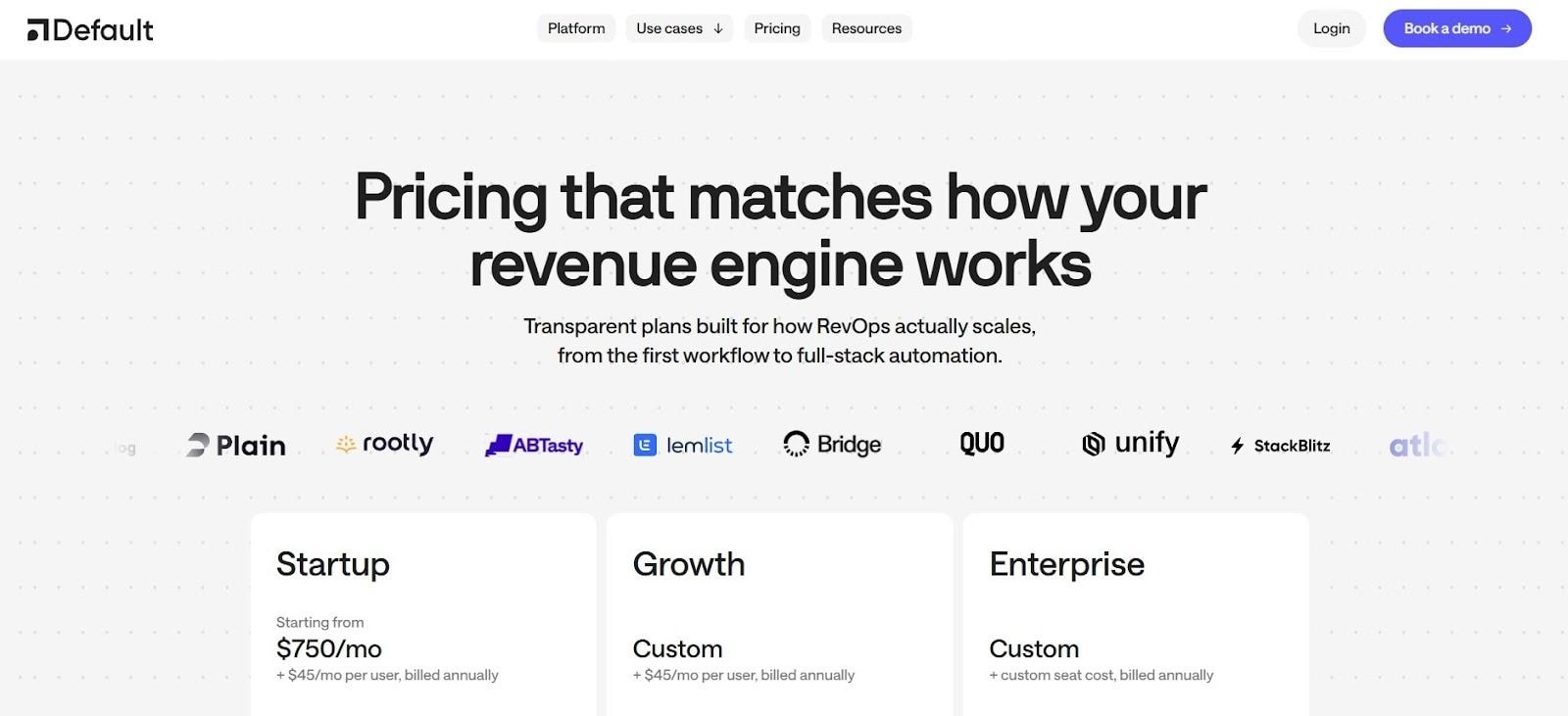
If you’re evaluating Chili Piper, chances are you’re trying to improve inbound routing without adding Salesforce complexity. Chili Piper focuses on booking and meeting handoffs. Default is built as a RevOps automation platform that governs the full inbound flow before scheduling happens.
Default provides:
- End-to-end qualification and routing
- Built-in enrichment and ICP scoring
- Territory and ownership governance controls
- Lifecycle automation with SLA monitoring
- Predictable pricing without volume-based penalties
This gives RevOps teams more control with less operational overhead.
Here’s a direct side-by-side pricing comparison.
How this plays out operationally
With Chili Piper:
- Each added product increases per-user cost
- Platform fees apply across modules
- Inbound growth can trigger higher pricing tiers
With Default:
- Platform pricing reflects workflow orchestration scope
- Seat pricing remains predictable
- Inbound spikes alone do not automatically inflate cost
Chili Piper pricing plans: A breakdow
Chili Piper uses modular pricing across Concierge, Distro, Handoff, Chat, and ChiliCal. Most mid-market and enterprise teams combine multiple products to manage inbound routing and distribution, which increases both total cost and operational complexity.
Below are the core products that most directly impact spend.
Concierge (inbound qualification and scheduling)

Concierge qualifies, routes, and schedules inbound leads directly from web forms. It supports enrichment, routing based on form and CRM data, spam filtering, and multi round-robin logic.
Pricing:
- $30 per user/month
- $150–$1,000/month platform fee (tiered by inbound lead volume)
Distro (Salesforce lead routing)

Distro routes and assigns Salesforce records based on territory rules, ownership logic, and round-robin distribution. It supports routing across Leads, Contacts, Accounts, and Opportunities.
Pricing:
- $30 per user/month
- $150/month platform fee
Handoff (SDR → AE scheduling)

Handoff routes and schedules meetings between SDRs and Account Executives based on defined routing rules such as region, industry, or account ownership. It supports round-robin logic and shared calendars.
Pricing:
- $30 per user/month
- $150/month platform fee
Chili Piper hidden costs
Chili Piper’s pricing appears straightforward: per-user licenses plus a platform fee. In practice, total ownership grows as routing logic, inbound volume, and team size expand.
Common hidden cost drivers include:
- Platform fee escalation as inbound lead volume increases
- Seat expansion as SDR and AE headcount grows
- Salesforce admin overhead from complex routing rules
- Product bundling across Concierge, Distro, and Handoff
- Ongoing implementation and governance maintenance
As GTM complexity rises, so does operational and financial impact.
Chili Piper pros & cons
Chili Piper is a capable routing and scheduling platform. Its value depends heavily on your GTM maturity, inbound volume, and Salesforce architecture.
Here’s a strategic breakdown from a RevOps perspective.
Pros
- Reduces lead-to-meeting time: Instant booking from web forms protects inbound SLAs and improves speed-to-lead performance — a critical metric for demand-driven teams.
- Improves SDR → AE coordination: Structured handoffs reduce internal scheduling friction, preserve meeting momentum, and support multi-step sales cycles.
- Automates Salesforce lead assignment: Distro minimizes manual routing, decreasing assignment latency and reducing human error in CRM workflows.
- Supports territory-based and round-robin logic: Useful for mid-market and enterprise teams that require segmented routing across regions, verticals, or account tiers.
Cons
- Cost scales with growth: Seat-based pricing and inbound-tiered platform fees increase total spend as SDR headcount and lead volume expand.
- Salesforce dependency: Advanced routing governance often requires ongoing CRM rule management and administrative oversight.
- Limited lifecycle orchestration: The platform focuses on booking and routing, without built-in enrichment, ICP scoring, or full-funnel automation.
- Modular pricing stacks: Many teams combine multiple products, increasing both operational complexity and overall cost.
Who is Chili Piper best for?
Chili Piper is best suited for GTM teams that primarily need to optimize meeting routing and internal handoffs, not redesign full-funnel revenue infrastructure.
Here’s where it fits most cleanly.
Inbound-focused demand gen teams
Strong fit for mid-market teams generating steady inbound volume who need to:
- Improve speed-to-lead performance
- Enable instant meeting booking from web forms
- Enforce basic territory routing
If your primary KPI is increasing MQL → meeting conversion and protecting inbound SLAs (without rearchitecting qualification or lifecycle automation), Chili Piper can deliver fast, tactical gains.
RevOps teams running Salesforce-centric routing
Well-suited for organizations deeply invested in Salesforce that want to:
- Automate lead assignment within CRM
- Enforce round-robin and territory distribution
- Reduce manual routing errors
If your routing logic already lives inside Salesforce and your goal is automation (not redesign), Chili Piper integrates cleanly into that structure.
SDR teams managing internal handoffs
Useful for sales organizations where:
- SDRs qualify before AE engagement
- Calendar coordination slows deal velocity
- Multi-step enterprise cycles require structured ownership transfer
If your core bottleneck is scheduling friction between roles — rather than upstream qualification accuracy or lifecycle governance — Chili Piper addresses that layer effectively.
Chili Piper customer reviews
Chili Piper earns strong ratings on platforms like G2. Reviews praise speed-to-lead and scheduling efficiency, while common concerns focus on pricing scalability and Salesforce complexity.
Positives
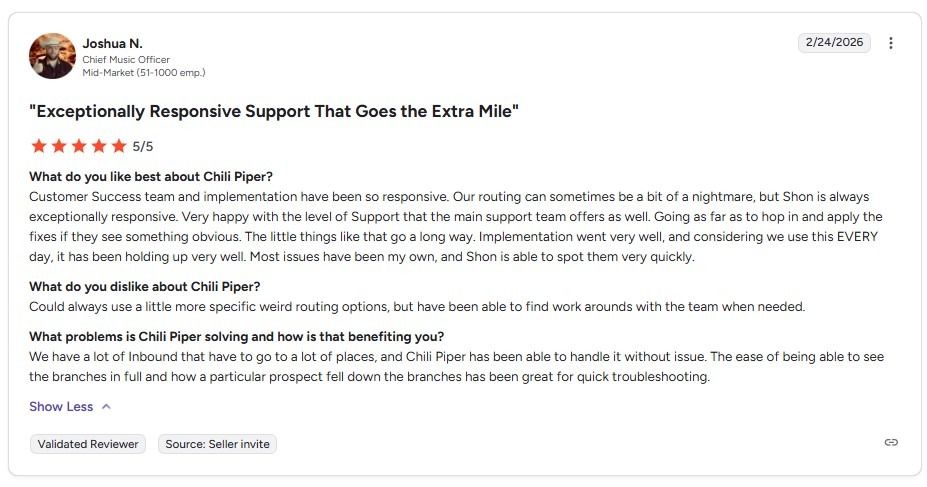
A validated G2 reviewer highlights responsive implementation and support, noting the team quickly resolves routing issues and proactively applies fixes. They report reliable daily performance and strong ongoing assistance, especially for complex routing setups.
Complaints
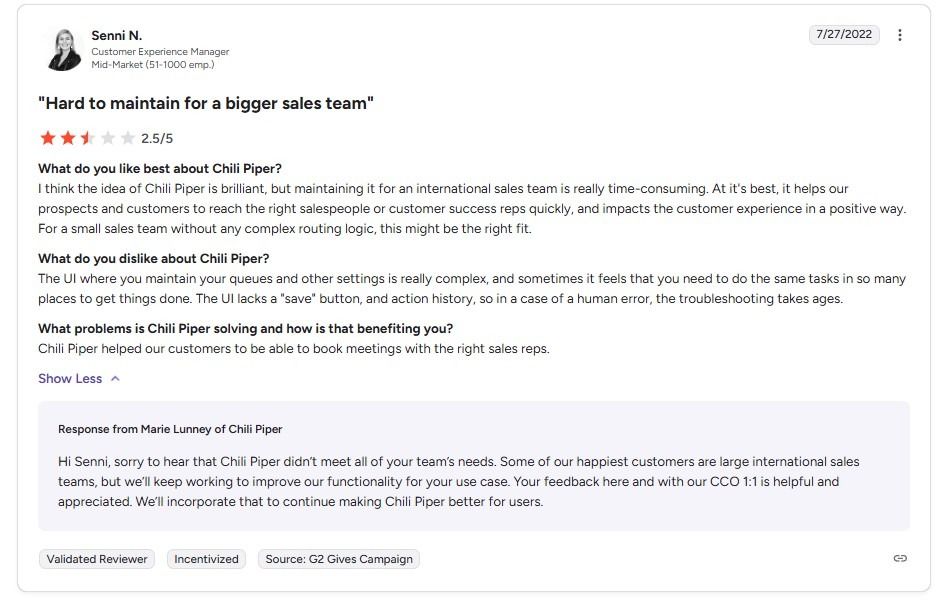
Another validated G2 reviewer notes the routing and queue management UI can feel complex, with repetitive configuration steps. They also mention the lack of a clear save button and action history, which makes troubleshooting human errors time-consuming.
Best alternative to Chili Piper: Default
Chili Piper is strong for meeting routing, SDR handoffs, and Salesforce distribution. But if your needs extend beyond scheduling — into enrichment, qualification control, SLA enforcement, and lifecycle governance — you need broader infrastructure.
Default is a RevOps automation platform that unifies enrichment, routing, and workflow governance into a single system.
Pre-routing qualification and enrichment

Default enriches and scores leads before routing. Teams apply ICP filters, ownership rules, and intent signals to prevent low-fit meetings and protect AE capacity.
Advanced routing and lifecycle governance
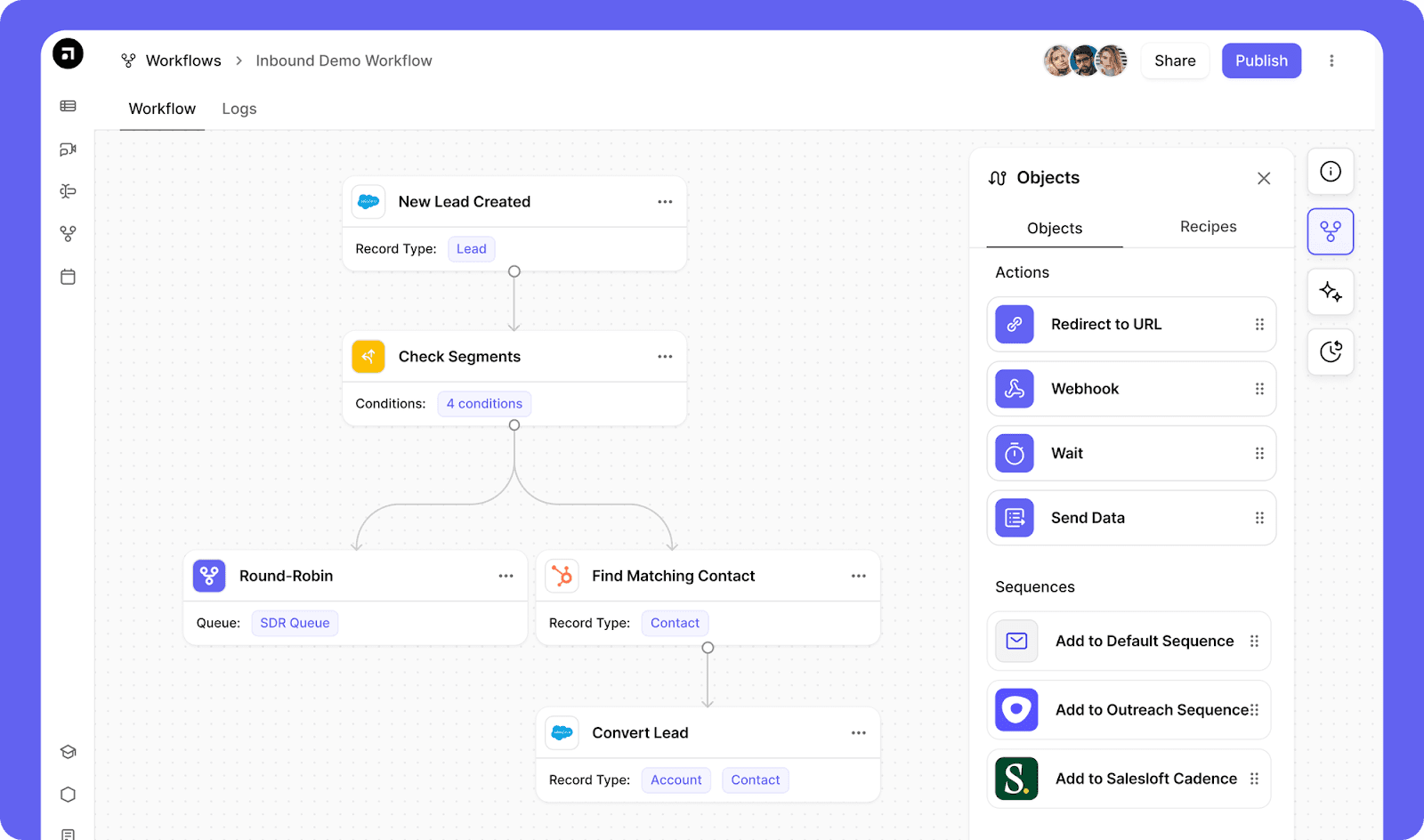
Default enables multi-variable routing and SLA enforcement without heavy Salesforce rule maintenance, giving RevOps greater control over pipeline flow.
See how Default can streamline your lead workflows
If Chili Piper’s pricing raises concerns about scaling costs or Salesforce overhead, it may be time to rethink your routing layer.
Default gives RevOps teams control over enrichment, qualification, routing governance, and SLA automation, without volume-based penalties.
Design a revenue system that scales with precision.
Book a live demo and model your routing logic today.